At the end of the last piece I changed a function’s return type from Order | null to Result<Order, "not_found">, called it a doorway, and walked off. This is what’s on the other side.
Here’s the pain it opens onto. You’ve written this handler. Find an order, make sure it can ship, ship it:
const handleShip = (orders: Order[], id: string) => {
  const order = orders.find(o => o.id === id);
  if (!order) return toast("That order doesn't exist.");
  if (order.status === "cancelled") return toast("Cancelled orders can't ship.");
  if (order.status !== "pending") return toast("That order's already on its way.");

  try {
    const shipped = ship(order); // throws if there's no inventory
    commit(shipped);
  } catch {
    toast("Couldn't ship — try again.");
  }
};
Look at how many different ways this thing fails. A null from .find. A sentinel comparison against a string. A thrown exception caught by a try/catch that’s quietly doing the job of an if. Three failure modes, three mechanisms, and here’s the part that should bother you: not one of them shows up in a type. ship is declared to return a ShippedOrder. The signature is a flat statement that it succeeds. The throw is a trapdoor in the floor that the type never mentions, and the only way to know it’s there is to have read the body, or to have fallen through it in production.
That’s the deeper problem with both of JavaScript’s built-in failure tools. A thrown exception is a goto: it teleports control out of your function to some catch you hope exists somewhere up the stack, and the compiler will not stop you from forgetting it. null is the same lie in a quieter voice, and it comes with a formal apology on record. Tony Hoare, who invented the null reference in 1965, calls it “my billion-dollar mistake.” Order | null admits something might be missing but does nothing to make you check, so the day you forget the if, the bug ships and the types smile and say everything’s fine.
The fix is the same move this whole series keeps making: stop reaching for control flow, reach for a value. Make failure a thing you return, not a thing that escapes. A function that can fail should say so in its type, hand you back a value that is either the success or the explanation, and refuse to let you read the success without acknowledging the failure. We started that at the end of the last piece. Let’s finish it.
A value that is success or failure
Here’s the type again, the one the last piece left on the table:
type Result<T, E> =
  | { ok: true; value: T }
  | { ok: false; error: E };
That’s the whole idea. A Result is one of two shapes: a success carrying a value, or a failure carrying an error. TypeScript won’t let you touch value until you’ve proven you’re on the ok: true branch. The failure isn’t off in a catch block. It’s right there in your hands, a value like any other, as inspectable as a number. Two tiny constructors make them pleasant to build:
const ok = <T>(value: T): Result<T, never> => ({ ok: true, value });
const err = <E>(error: E): Result<never, E> => ({ ok: false, error });
Now rewrite the three steps so each one returns its failure instead of throwing it, finding it, or hiding it. Errors, for the moment, are just strings that name what went wrong:
type ShipError = "not_found" | "cancelled" | "already_shipped" | "no_inventory";

const findOrder = (orders: Order[], id: string): Result<Order, ShipError> => {
  const found = orders.find(o => o.id === id);
  return found ? ok(found) : err("not_found");
};

const ensureShippable = (order: Order): Result<Order, ShipError> => {
  if (order.status === "cancelled") return err("cancelled");
  if (order.status !== "pending") return err("already_shipped");
  return ok(order);
};

const applyShipment = (order: Order): Result<Order, ShipError> =>
  inStock(order) ? ok({ ...order, status: "shipped" }) : err("no_inventory");
Three honest functions. Each one’s type now tells the truth: give me this, and you’ll get back either what you wanted or a reason you didn’t. But honesty alone hasn’t bought us much yet. If anything we’ve made more work, because now every caller has to unwrap a Result. String three of these together by hand and you get exactly the nightmare the skeptics warn you about:
const found = findOrder(orders, id);
if (!found.ok) return found;
const shippable = ensureShippable(found.value);
if (!shippable.ok) return shippable;
const shipped = applyShipment(shippable.value);
if (!shipped.ok) return shipped;
commit(shipped.value);
Unwrap, check, unwrap, check. This is the moment people decide functional error handling is a tax and go back to throwing. They’re right about the pain and wrong about the cure. The pain isn’t Result. It’s that we’re unwrapping by hand. There’s a track running underneath all that repetition, and once you see it, the boilerplate disappears.
The railway
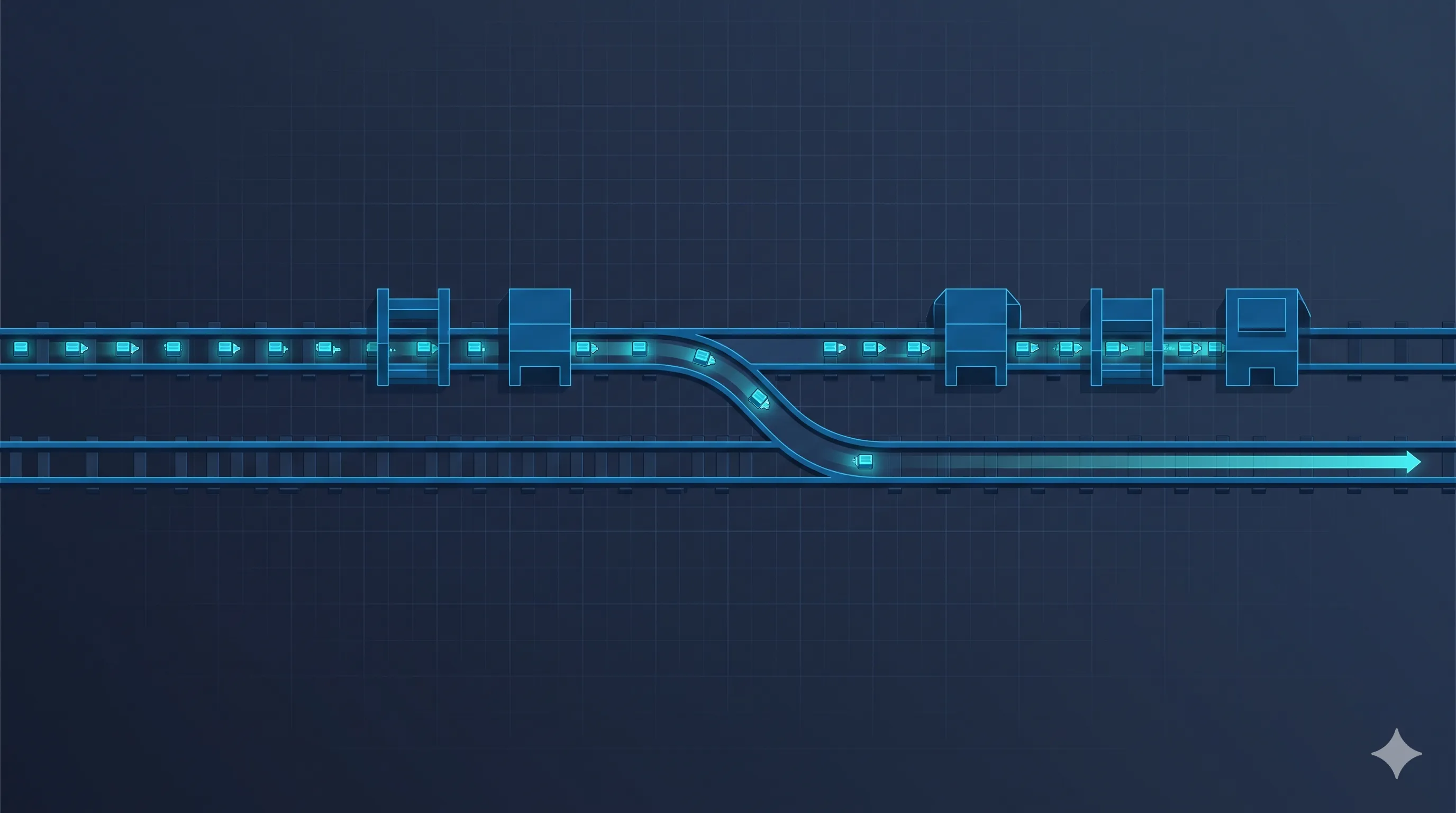
Picture two parallel rails. The top rail is the success track. The bottom is the failure track. Your data rides in on the top, moving left to right through one step after another. As long as everything succeeds, it stays up top, station to station. The instant a step fails, it gets switched down onto the failure track. And the failure track is express. It runs straight past every remaining station, untouched, to the far end, where you handle it once.
That’s the whole picture. Now we need exactly one tool to build it: a way to chain a step onto the track that knows to do nothing when we’re already on the failure rail. That tool is flatMap.
const flatMap =
  <T, U, E>(f: (value: T) => Result<U, E>) =>
  (r: Result<T, E>): Result<U, E> =>
    r.ok ? f(r.value) : r;
Read it in English: if we’re still on the success track, run the next step; if we’ve already failed, pass the failure straight through and don’t run anything. That : r is the express track, the short-circuit, in one character. Its quieter siblings round out the kit:
const map =
  <T, U>(f: (value: T) => U) =>
  <E>(r: Result<T, E>): Result<U, E> =>
    r.ok ? ok(f(r.value)) : r;

const mapError =
  <E, F>(f: (error: E) => F) =>
  <T>(r: Result<T, E>): Result<T, F> =>
    r.ok ? r : err(f(r.error));
map transforms the success when the step can’t fail. mapError rewrites the failure (turn a low-level error into a user-facing one) without touching the success. Three functions, and notice every one of them is the same r.ok ? … : … shrug: is this still on the happy path? then act; otherwise get out of the way.
With flatMap in hand, remember pipe from the last piece, the four-liner that runs a value through a list of functions left to right? This is the job it was waiting for:
const pipe = <T>(value: T, ...fns: Array<(x: T) => T>): T =>
  fns.reduce((acc, fn) => fn(acc), value);

const result = pipe(
  findOrder(orders, id),
  flatMap(ensureShippable),
  flatMap(applyShipment),
);
That is the entire railway. The unwrap-check-unwrap-check ladder collapsed into three lines that read top to bottom like a description of the happy path, because that’s what they are. If findOrder fails, ensureShippable and applyShipment never run. The not_found rides the express track untouched all the way to result. No try. No re-checking. The short-circuit you used to spell out by hand is now baked into the one combinator doing the chaining.
Handle it once, at the edge
The pipeline produces a Result, and at the boundary, where you actually talk to the user, you finally split the two tracks apart and deal with each:
if (result.ok) {
  commit(result.value);
} else {
  switch (result.error) {
    case "not_found":
      return toast("That order doesn't exist.");
    case "cancelled":
      return toast("Cancelled orders can't ship.");
    case "already_shipped":
      return toast("That order's already on its way.");
    case "no_inventory":
      return toast("Out of stock — can't ship yet.");
    default:
      return assertNever(result.error);
  }
}
This is the same exhaustiveness trick from the last piece, the Record<Status, string> that wouldn’t compile if you forgot a status, except now it’s load-bearing. assertNever is the lock:
const assertNever = (x: never): never => {
  throw new Error(`Unhandled error: ${JSON.stringify(x)}`);
};
Because result.error is a finite union of strings, TypeScript narrows it case by case. Handle every one and the default branch receives never, which is fine. Miss one — or, six months from now, add "address_invalid" to ShipError and forget this switch — and the leftover case is no longer never, so assertNever won’t accept it and the build breaks before the bug does. That’s the trade you’ve made: the failure that used to slip through a forgotten if is now something the compiler refuses to let you ignore.
When a string isn’t enough
Strings name a failure but can’t carry anything. The moment a caller needs more than the name, the string runs out of room: how many were in stock, which tracking number the order already has. So let the error grow up into a shape of its own:
type ShipError =
  | { kind: "not_found" }
  | { kind: "cancelled" }
  | { kind: "already_shipped"; trackingNumber: string }
  | { kind: "no_inventory"; available: number };
Each error still announces itself through a literal, the kind field, but now it can carry exactly the data that failure has to explain, and only that data. no_inventory knows how many are available. not_found carries nothing because there’s nothing to say. The producers barely change (err({ kind: "no_inventory", available: stock(order) })), and the handler gets richer while staying just as exhaustive:
switch (result.error.kind) {
  case "no_inventory":
    return toast(`Only ${result.error.available} left — can't ship the full order.`);
  case "already_shipped":
    return toast(`Already shipped under ${result.error.trackingNumber}.`);
  // …the rest, still compiler-enforced
}
Inside case "no_inventory", TypeScript knows result.error has an available: number. Inside already_shipped, it knows there’s a trackingNumber. Each branch is narrowed to precisely the fields that error carries, and reaching for a field that doesn’t belong to this case won’t compile.
That little { kind: … } union has a name, a discriminated union, and it’s one of the most useful tools in TypeScript’s whole box. (You’ve actually been using one this entire time: Result itself is a discriminated union, split on ok.) It deserves a piece of its own and gets one here. For now you only need the shape. Because here’s where it stops being a tidy way to model errors and becomes something bigger.
Make the illegal states impossible
Look back at the Order type the last piece has been carrying around:
type Order = {
  id: string;
  customer: string;
  total: number;
  status: Status; // "pending" | "shipped" | "delivered" | "cancelled"
  placedAt: string;
};
This type lies, and it lies in the same way Order | null did: by permitting things that can’t be true. A "shipped" order with no tracking number. A "cancelled" order with no reason. A "delivered" order that was never shipped. Every one of those is a value this type happily lets you build, and every one is why the codebase is salted with defensive checks like if (order.status === "shipped" && order.trackingNumber), and with the non-null assertions (order.trackingNumber!) you write to shut the compiler up when you know it’s there. You know, but the type doesn’t.
Use the discriminated union to make the type know. Split Order on status, and give each variant exactly the fields that status requires:
type OrderBase = {
  id: string;
  customer: string;
  total: number;
  placedAt: string;
};

type Order =
  | (OrderBase & { status: "pending" })
  | (OrderBase & { status: "shipped"; trackingNumber: string })
  | (OrderBase & { status: "delivered"; trackingNumber: string; deliveredAt: string })
  | (OrderBase & { status: "cancelled"; reason: string });

type ShippedOrder = Extract<Order, { status: "shipped" }>;
Now trackingNumber exists only when status is "shipped" or "delivered". There is no such thing as a shipped order without one, not because you remembered to check, but because the type can’t represent it. The defensive ifs don’t get fixed. They get deleted, because the situation they guarded against can no longer occur. The ! assertions go with them. This is the principle the whole second half of the series turns on: make illegal states unrepresentable. The phrase is Yaron Minsky’s, coined at Jane Street, where typed functional code moves real trading money. Don’t validate that the data is well-formed all over the codebase. Shape the type so malformed data can’t be constructed in the first place.
And it pays off the railway directly. Sharpen applyShipment to return the shipped variant:
const applyShipment = (order: Order): Result<ShippedOrder, ShipError> =>
  inStock(order)
    ? ok({ ...order, status: "shipped", trackingNumber: nextTracking() })
    : err({ kind: "no_inventory", available: stock(order) });
Try to ship without producing a tracking number (ok({ ...order, status: "shipped" })) and it no longer compiles, because a ShippedOrder is an order with a tracking number, by definition. The guarantee ensureShippable enforced at runtime, the type now enforces at compile time. The railway was about handling failure gracefully when it happens. This is about deleting a whole class of failure so it can’t.
The shape underneath
Step back and look at flatMap again, because you’ve quietly built something with a much longer history than “error handling.”
A Result is a box that holds one of two things and lets you keep working on the inside without prying the lid off. Option is the cousin for a value that’s simply absent, with no error to explain, no story to tell. It’s the same box with a plainer label:
type Option<T> = { some: true; value: T } | { some: false };

const flatMapOption =
  <T, U>(f: (value: T) => Option<U>) =>
  (o: Option<T>): Option<U> =>
    o.some ? f(o.value) : o;
Look at the body. It’s flatMap for Result with the words changed. Reach inside if there’s something there; otherwise pass the emptiness through untouched. Reach for Result when a missing thing comes with a reason (“not found, because…”). Reach for Option when it’s just not there. Same machine, different cargo.
And here’s the one you use a hundred times a day without thinking of it this way:
fetchOrder(id) // Promise<Order>
  .then(order => fetchCustomer(order.customerId)); // Promise<Customer>
.then takes the value out of a Promise, runs a function that returns another Promise, and hands you back a single flattened Promise. It doesn’t nest. That’s flatMap. A Promise is a box holding a value-that-isn’t-here-yet, and .then is how you keep working on the inside without cracking it open. You’ve been doing functional error handling’s central move on every async call in your career.
Result, Option, Promise: three boxes, each holding its own kind of “maybe not a plain value,” and each with the same way of chaining a next step that knows how to do nothing when there’s nothing to do. When a shape recurs that insistently, it earns a name. This one is called a monad: a box with a flatMap (and a way to put a value in). That’s it. That’s the word that launched a thousand impenetrable tutorials, and you just built three of them from scratch and used them to ship an order. The abstraction was never the hard part. It was only ever the name for the pattern you’d have arrived at anyway.
One honest asterisk, since a pedant will raise it if I don’t: Promise is the imperfect cousin. A real monad nests: a Result<Result<T>> is a genuine thing you flatMap flat on purpose. But Promise auto-flattens (there’s no Promise<Promise<T>>), and its .then is overloaded to do both map and flatMap at once. So it breaks the laws a purist cares about. It’s still the most useful intuition pump you’ve got for what flatMap feels like, which is why I’m using it and flagging it in the same breath.
If you go looking for these in the wild, the vocabulary shifts: the functional world has carried Result for decades under the name Either. Either<E, A> is the same two-shape box, with the error conventionally on the Left and the success on the Right. Same idea, older name. Now you can read both.
Where it’s not worth it
A pattern you can’t say no to is a religion, not a tool, so here’s the line. Result is for expected, recoverable failures: the ones that are part of your domain. An order isn’t found. A shipment has no stock. A form field is malformed. Those aren’t exceptional. They’re Tuesday, and they belong in your types.
A genuinely exceptional condition is different, and exceptions are still the right tool for it. A broken invariant, a config that should exist and doesn’t, an “this should be impossible” branch, an out-of-memory: those mean the program is in a state you have no recovery for, and a thrown exception that crashes loud and early is exactly what you want. Don’t wrap your null-pointer bugs in a Result. Let them blow up where you’ll see them. The rule of thumb: if a caller can sensibly do something about the failure, return it as a value; if there’s nothing to do but abort, throw. And keep Result at the seams where real fallibility lives (the fetch, the parse, the transition), not threaded through every pure leaf helper, which just turns simple code into plumbing.
Where this gets industrial
Everything above is hand-rolled on purpose: eleven lines of Result, ok, err, map, flatMap, mapError and you have a working railway with nothing installed. That’s the point: the concept owes nothing to a library. But it does get verbose. A long flatMap chain has more ceremony than a try/catch, the hand-rolled pipe stops type-checking cleanly the moment a step changes the value’s type (watch it strain when applyShipment turns an Order into a ShippedOrder), and async drags Promise<Result<T, E>> into everything. That friction is exactly where the libraries earn their keep:
- neverthrow is the closest to what you just built: a focused
Resultwith chainable methods and aResultAsyncthat handles thePromise<Result>knot we sidestepped here. The lightest possible upgrade from hand-rolled. - Effect is the industrial end: typed errors, dependencies, and async all modeled as composable values, with the whole pipeline machinery built in. It’s where this thinking goes when “errors as values” grows into “effects as values,” which, not coincidentally, is a piece of its own.
- fp-ts is the classic, Haskell-faithful lineage where
EitherandOptioncome from, if you want the vocabulary at its source.
Reach for one when the hand-rolled version starts to chafe, not before. The idea is the asset. The library is just where it gets comfortable at scale.
The doorway
The railway is only ever as honest as the data that boards it. Every step above trusted that orders was a real array of well-formed Orders. But that array came off the network as any, parsed from JSON that some server promised, not your compiler. We made illegal states unrepresentable inside the program. The front door is still wide open. The move that closes it is the next piece: parse untrusted input exactly once, at the boundary, into a type that cannot be invalid, so nothing downstream ever has to check again. That’s Parse, Don’t Validate.
You walked in throwing exceptions and forgetting null checks. Now failure is a value you return, a railway composes your fallible steps without a single try, illegal states won’t compile, and the scary word turned out to be a box with a flatMap. Your errors aren’t accidents that escape your functions anymore. They’re part of what your functions are.